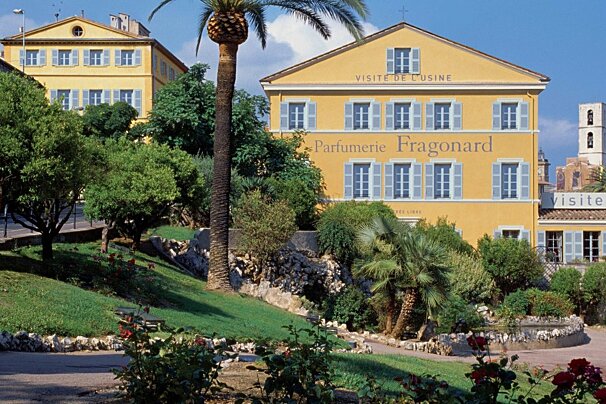
Parfumerie Fragonard, Grasse
This historic perfume factory is in the heart of the Old Town and is one of the oldest in Grasse, constructed in 1782.
Discover and book the top Nice sights
This historic perfume factory is in the heart of the Old Town and is one of the oldest in Grasse, constructed in 1782.

The most important orthodox cathedral outside Russia, this is a beautifully ornate building. It was built to serve the large Russian community that had settled in Nice.

The world-famous painter Pierre-Auguste Renoir lived at La Ferme des Collettes with his family from 1907 until his death in 1919. Renoir moved to Cagnes-Sur-Mer in the hopes that the warm climate would improve his arthritis, which eventually confined him to a wheelchair. The house in which he spent the last 12 years of his life is set in a beautiful estate full of citrus and olive trees, looking out along the coastline all the way to way to the Cap d’Antibes.

Come and see bison, deer, horses, boars and hawks roaming on 700 hectares of land, just one hour from the French Riviera

With items from prehistoric times, and fine arts and decorative arts from as early as the 17th century, all the way up to the first half of the 20th century.

A small collection of some of Matisse's works and items from his own personal collection and that of his descendants are housed in an impressive 17th century Genoese mansion.

This astronomical observatory is located on top of mont Gros. It was built in 1881 and was designed by Charles Garnier, architect of the Paris Opera House, and Gustave Eiffel, the celebrated creator of the Eiffel Tower.

Founded as a photographic studio in 1958, and opened as a gallery in 1972, Jean Ferrero exhibited works from the School of Nice and the New Realism genre.

This museum was set up by outstanding chef Auguste Escoffier who worked as head chef at the Savoy in London. He founded this museum which is dedicated to culinary art.

Founded by Jean Baptiste Barla in 1850 (locals know it as Museum Barla), this museum showcases a rich collection of zoological, botanical and geological specimens.

Located in the Allianz Riviera Stadium in Nice, this museum houses more than 45,000 objects ad 400,000 dedicated to all sports, showing their history from the Antiquity to the present.

At the edge of the sea, facing the Saint-Jean-Cap-Ferrat peninsula, the villa is a magic place that takes you back in time. Discover this French Riviera seaside palazzo, a luxurious recreation of an Ancient Greek villa.

Free guided tours of a historic perfume factory in the medieval village of Eze.

The area around the Cote d'Azur is rich in prehistoric artefacts, many of which can be found in this fascinating museum.

The museum of palaeontology is located on the excavation site of the Terra Amata where there is evidence of human inhabitation going back 400,000 years.

Beautiful baroque architecture, examples of 17th- and 18th-century frescoes and furniture and a large terraced garden.

Just outside Saint-Paul de Vence lies one of France's most famous modern and contemporary art museums. Surrounded by pleasant gardens, this is a nice place to spend your afternoon.

Guarding the Bay of Angels, this 19th-century tower is where composer Hector Berlioz created the opening of the famous King Lear overture in 1831, whilst staying here.